
Free competitive maths practice
Learn to solve maths problems
Learn how to turn a graph, a sequence, or a counting problem into something you can solve. Each lesson gives you a worked example, a short exercise, and a challenge to try next.
Browse lessons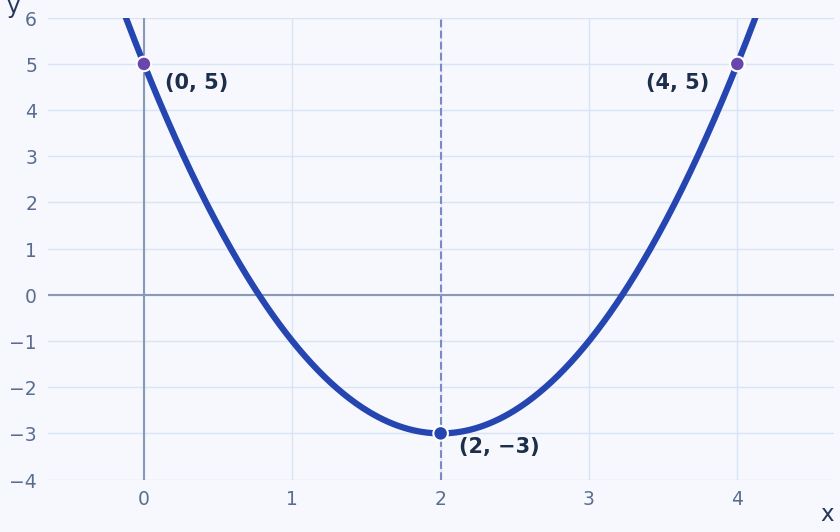
In-depth guides
- Prime numbers and reversible primesLearn trial division, the sieve of Eratosthenes and digit reversal using small, verifiable examples.
- Dynamic programming and grid pathsCount routes, handle obstacles and derive a reusable recurrence instead of enumerating every path.
- Graph transformations: shifts, scales and reflectionsIdentify how a parent curve moves or changes shape by following its defining points.
- Piecewise functions and domain restrictionsBuild graphs from intervals, test endpoints, and distinguish corners from jumps and holes.
- Trigonometric graphs: amplitude, period and phaseRead the midline, height and repeat distance of a sinusoid, and check phase using a landmark.
- 3D geometry: planes, surfaces and slicesIdentify planes and curved surfaces by taking coordinate sections and checking points away from the axes.
- Sequence patterns: differences, recurrences and interleavingSeparate alternating subsequences, use differences, and validate a pattern instead of guessing.
- Number theory: divisors, gcd and modular arithmeticFactor integers, count divisors and reduce large arithmetic expressions with remainders.
Write an equation from a 2D graph
Use the vertex to locate the parabola, then use another point to determine its scale.
Worked example
The graph at the top of the page has vertex (2, −3) and passes through (4, 5). Find an equation for it.
- Place the vertex. In
y = a(x − h)² + k, useh = 2andk = −3. This givesy = a(x − 2)² − 3. - Calculate the scale. At x = 4, the height is 8 units above the vertex and the horizontal distance is 2. Solve
8 = 4ato geta = 2. - Check another point. x = 0 is also two units from the symmetry line x = 2, so the graph should have height 5 there as well.
Vertex form
y = 2(x − 2)² − 3
In X-Plot, enter y = 2*(x - 2)^2 - 3. If you see the lowest point at x = −2, check the sign inside your brackets.
Try it
A parabola has vertex (−1, 4) and passes through (2, −5). Find its equation and its height at x = −4.
Show hint
Measure the horizontal displacement from −1 to 2. The vertical change from the vertex is −9.
Show solution
a = −9 ÷ 3² = −1, so the equation is y = −(x + 1)² + 4. At x = −4 the height is −5. Both points are three units from the symmetry line.
Decide where to shade an inequality
Use the equality to draw the boundary. Then check which points the inequality includes.
Worked example
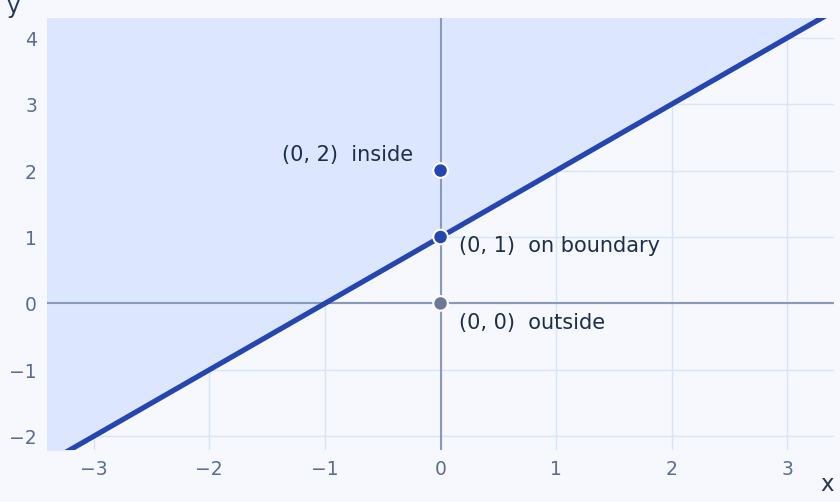
Plot the solution region for y ≥ x + 1.
- Draw the boundary.
y = x + 1passes through (0, 1) and (1, 2). Draw a solid line because equality is allowed. - Test a point off the line. At (0, 2),
2 ≥ 1is true. At (0, 0),0 ≥ 1is false. Shade the side containing (0, 2). - Check the edge. At (0, 1),
1 ≥ 1is true. With a strict inequality, use a dashed line and exclude the boundary points.
Try it
For y < −2x + 3, should the line be solid or dashed? Which of (0, 0) and (1, 1) belongs to the solution region?
Show hint
Substitute each point. One gives equality, so pay attention to the strict inequality.
Show solution
The boundary is dashed and the region is below it. At (0, 0), 0 < 3 is true. At (1, 1), 1 < 1 is false, so that point is excluded.
Use cross-sections to read a 3D graph
Hold one input fixed to simplify the surface. Then use a point away from both axes to check what the slices missed.
Worked example
A surface has slice z = 2x² when y = 0, and slice z = −y² when x = 0. Its height at (1, 1) is 4. Assume the only additional term is cxy.
- Combine the two slices. Start with
z = 2x² − y². One axis curves up and the other curves down. - Test off the axes. At (1, 1), the candidate gives 1, so it is three units too low. Add
3xyto get the desired height of 4. - Check another direction. The mixed term vanishes on both original slices. At (1, −1), the new equation predicts
2 − 1 − 3 = −2.

Try it
Now the same slices give a surface with height 0 at (1, 1). Find c in z = 2x² − y² + cxy and predict the height at (1, −1).
Show hint
The term cxy equals c at (1, 1) and −c at (1, −1).
Show solution
At (1, 1), 2 − 1 + c = 0, so c = −1. At (1, −1), the height is 2 − 1 + 1 = 2. In the 3D Studio, enter z = 2*x^2 - y^2 - x*y to compare the two directions.
Use differences to test a sequence rule
A constant second difference suggests a quadratic rule. Use the rule to predict a term, then check it against the sequence.
Worked example
Continue 5, 11, 21, 35, 53 assuming the second difference stays constant.
- Write the jumps. They are 6, 10, 14, 18. Each is four greater than the previous one.
- Predict the next term. The next jump is 22, so the next term is
53 + 22 = 75. - Find a rule. The second difference of
n²is 2. Subtract2n²from term n, starting with n = 1. Every remainder is 3, soaₙ = 2n² + 3.
| Term | 5 | 11 | 21 | 35 | 53 |
|---|---|---|---|---|---|
| First | 6 | 10 | 14 | 18 | |
| Second | 4 | 4 | 4 |
Several rules can fit a finite list. If the question gives a diagram or a construction, check that your rule matches how it grows.
Try it
For 4, 9, 16, 25, 36, assume constant second differences. Find the next term and a formula starting at n = 1.
Show hint
Find the jumps and subtract n² from each term. What changes by a constant amount in what remains?
Show solution
The jumps are 5, 7, 9, 11, then 13. The next term is 49. Subtracting n² leaves 3, 5, 7, 9, 11, which follows 2n + 1. So the formula is aₙ = (n + 1)².
Count multiples without double-counting
When two groups overlap, add their sizes and subtract the items you counted in both.
Worked example
How many integers from 1 to 80 are divisible by 6 or 10?
- Count each group. The count of multiples of d from 1 to N is the whole-number part of N ÷ d. Here the counts are 13 and 8.
- Find the overlap. A multiple of both 6 and 10 is a multiple of their least common multiple, 30. There are two, 30 and 60.
- Subtract the repeated counts. The answer is
13 + 8 − 2 = 19. As a check, each complete block of 30 contributes seven, and 61 through 80 contribute five.
Where the 19 come from
- Divisible by 6 only
- 11
- Divisible by both
- 2
- Divisible by 10 only
- 6
Use the least common multiple, 30. Using the product 60 would miss 30.
Try it
How many integers from 20 through 100 are divisible by 4 or 6?
Show hint
Find the count through 100, then subtract the count through 19. Multiples of both 4 and 6 are multiples of 12.
Show solution
(25 + 16 − 8) − (4 + 3 − 1) = 27. Subtracting through 19 keeps 20 in the range, where it qualifies as a multiple of 4.
Use remainder cycles to handle large powers
Keep only the remainder at each step. Once a remainder repeats, the same multiplication rule makes the future steps repeat too.
Worked example
Find the last digit of 3⁴⁷. The last digit is the remainder after dividing by 10.
- Build the cycle. The first four remainders are 3, 9, 7, 1. Each comes from multiplying the previous remainder by 3 and keeping the units digit.
- Check the repeat. After 1, the next remainder is 3 again. The cycle beginning with exponent 1 has length 4.
- Locate the exponent.
47 = 11 × 4 + 3, so use the third entry, 7. A remainder of zero in the exponent division would mean the fourth entry.
| Exponent | 1 | 2 | 3 | 4 |
|---|---|---|---|---|
| Last digit | 3 | 9 | 7 | 1 |
Some sequences enter a cycle after a few initial terms. Record where the repetition starts before reducing the exponent.
Try it
Find the remainder of 2³⁹ when divided by 5.
Show hint
Write the first four powers of 2 as remainders modulo 5. Multiply each remainder by 2 to get the next.
Show solution
The remainders are 2, 4, 3, 1, then 2 again. Since 39 = 9 × 4 + 3, the remainder is the third entry, 3.